


Buying a new table sounds simple until you start comparing prices. One dining room table may cost a few hundred dollars, while another dining table with a similar shape can easily cost more than $1,500. So, how much should a dining table cost, and what are you actually paying for?
For many households, a practical dining table budget falls somewhere between $400 and $1,000. Entry-level furniture made with engineered wood or veneers can start around $150 to $500, while a higher quality solid wood dining table often costs $500 to $1,800 or more.
There is no single right price. The amount you should spend depends on materials, table size, seating capacity, craftsmanship, finish options, delivery, and how long you hope to keep the table.
What Affects the Price of a Dining Room Table?
The biggest factor is usually material.
A dining table made from solid wood requires more raw material than a table built with engineered wood and veneers. Hardwoods such as oak, maple, cherry, and walnut also tend to cost more because they are valued for strength, grain, and the ability to age well.
Premium-grade hardwoods with fewer knots usually increase the price again.
A table using oak veneer or ash veneer can be more affordable while still providing the appearance of real wood. Veneers consist of a thin layer of real wood attached to a more stable core. They can also help reduce some of the expansion and contraction associated with solid hardwoods.
That makes a well-made oak veneer dining table a practical option for someone who wants a warm wood look without paying for an entirely solid oak tabletop.
Construction also matters. A basic table with four straight legs is generally easier to produce than a dining room table with a sculptural stand, pedestal center, complex joinery, or polished decorative base.
Larger rectangular dining tables need more materials, wider packaging, and more expensive freight. Heavy furniture also costs more to store and deliver. If assembly required is included in the product design, the way the table is packaged and assembled can also affect the final price.
-0.png?w=2528&h=1264)
What Do You Get at Different Price Points?
At around $150 to $500, you will usually find engineered wood, veneers, simpler legs, and more assembly-required furniture.
This price range can work well for a first apartment, breakfast area, temporary home, or compact kitchen table. A good table at this level can still be stable and attractive—you simply need to check the materials and construction carefully.
Between $500 and $1,000, shoppers can usually expect a broader selection of solid wood components, thicker tabletops, better finish options, and more substantial dining room furniture.
Once you move toward $1,000 to $1,800, solid wood dining tables become more common. These tables may use oak, maple, cherry, or other hardwoods and can offer greater long-term flexibility because real wood can often be sanded and refinished.
Above that price, you may be paying for hand-crafted construction, elaborate bases, customization, a marble or stone tabletop, more complex interior design details, or premium finishing work.
That does not mean the most expensive table is automatically the best table for your family.
Solid Wood vs. Veneers: Which Is Worth the Money?
If you want a dining table that can stay in your home for many years, solid wood has a strong advantage.
Oak, walnut, maple, and cherry can develop character over time. A scratch on a real wood tabletop can often be sanded or refinished. If the finish becomes worn after years of family meals, you may be able to refinish the surface instead of replacing the whole dining table.
Veneers work differently.
A quality oak veneer or ash veneer can give the table an attractive wood appearance at a lower price. Because veneers are applied over a stable core, they can also reduce movement as natural wood reacts to humidity.
The challenge is that a thin veneer cannot be sanded repeatedly. If you hope to refinish your dining room table several times in the future, solid wood is the safer choice.
If your goal is style and value rather than decades of refinishing, a well-made veneer table can still be a smart purchase.
How Many People Should Your Dining Table Seat?
Before you shop by style, decide how many people the table needs to accommodate.
Each diner generally needs about 22 to 24 inches of width along the table edge. In practical terms, plan on roughly two feet per person.
A dining table for four should usually be at least about four feet long. Square dining tables are often a natural fit for four diners, especially in square rooms.
A square dining table can make the seating feel balanced, but it becomes less space-efficient when you want to accommodate more guests.
Rectangular dining tables usually work better for families and larger gatherings. They also tend to match rectangular rooms more naturally. If your dining room is long and narrow, a rectangular table can create better visual balance than a large round design.
Round dining tables are useful when space is tighter. A round table can comfortably seat two to four people while eliminating sharp corners and making it easier for diners to see one another.
Round tables can also create a softer look in interior design, especially when the dining room has a lot of straight walls and rectangular furniture.
Measure the Room Before You Decide on Price
An expensive table that does not fit the room is still the wrong table.
Measure your dining room and subtract approximately six feet from the room's length and width. That gives you around three feet of space on each side for pulling out chairs and walking behind seated diners.
Also check table depth and seating clearance.
Most dining chairs have an approximately 18-inch seat height, and the distance between the seat and tabletop should generally remain around 10 to 12 inches.
Make sure chairs can tuck underneath the table without hitting the legs or center stand.
If you are taping out the dimensions on the floor, include the chairs too. People often measure the table but forget how much room comfortable seating requires once guests are sitting down.
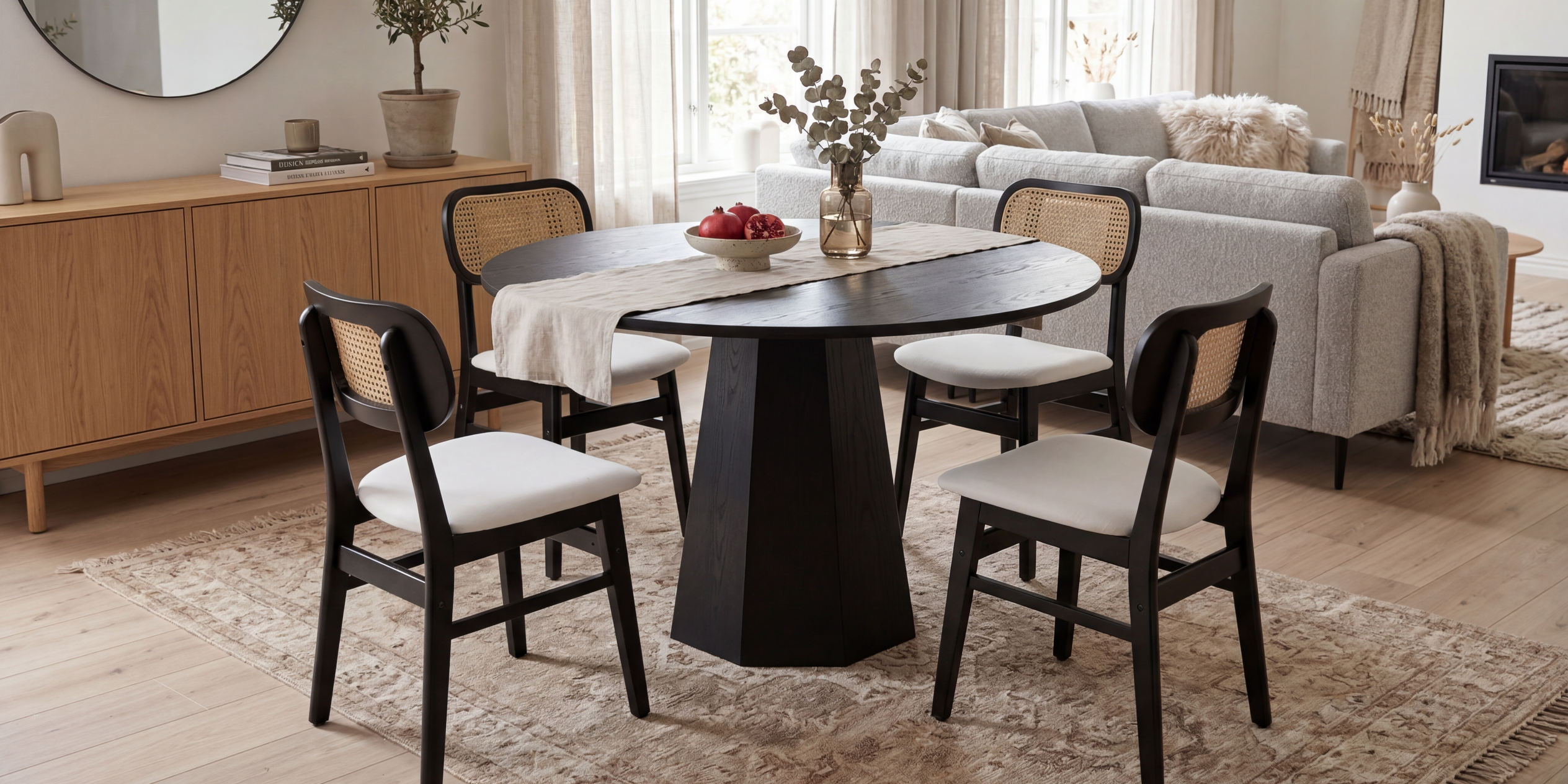
Should You Spend More on an Extendable Table?
If you regularly invite friends or family over, an extendable dining table can be worth the additional price.
A table with a removable or built-in leaf allows you to keep the dining area more compact day to day, then create additional seating when guests arrive.
This can be especially helpful if your dining room cannot permanently accommodate a large table.
For example, a six-person table might work for daily family use, while an extension leaf allows you to increase maximum seating for holidays or dinner parties.
That space-saving flexibility may provide more value than simply buying a larger table from the beginning.
What About Dayalane Dining Tables?
Dayalane's dining collection includes round, rectangular, and oval dining tables designed for different room sizes and seating needs. Its assortment ranges from compact tables to larger options intended for six to eight seats.
The Clark dining table, for example, is one Dayalane option where useful product specifications go beyond style alone. Dayalane publishes dimensions and a stated 600-pound table capacity for the Clark, which gives shoppers something concrete to compare when evaluating construction and stability.
Dayalane also offers dining sets where a table can be paired with chairs, including configurations designed around different household sizes.
When comparing any dining table, these measurable details are more useful than simply judging whether the table looks good in a store photo.
Remember to Budget for Chairs
The table is only one part of the dining room.
Dining chairs can easily start around $150 each, so a set of four or six chairs can add significantly to the final price. If you want upholstered comfortable seating, higher-end materials, or solid wood chair frames, the total can rise quickly.
That means it may be smarter to buy a $700 dining table and leave room in the budget for quality chairs rather than spend $1,200 on the table and compromise on seating.
Think about placemats, coasters, delivery, and assembly too. These smaller costs can add up, particularly with heavy furniture.
How to Tell Whether a More Expensive Table Is Worth It
Before paying more, look at what actually improves.
Is the tabletop solid wood rather than a thin veneer? Are the legs more stable? Is the surface smooth and well finished? Can the table be refinished later? Does the larger width or depth create more useful seating? Is the table crafted from better hardwoods?
A polished marble surface or detailed pedestal may enhance the room visually, but it may not improve everyday functionality.
Likewise, a soft wood may scratch more easily than oak or walnut even if the table costs more because of its design.
Do not shop by price alone. Watch for construction quality, the way the legs attach, tabletop thickness, finish consistency, and how stable the table feels when pressure is applied near the corners.
So, How Much Should You Spend?
For a first home, apartment, or kitchen, $150 to $500 can buy a practical table made with engineered wood, oak veneer, ash veneer, or mixed materials.
For most families wanting a dining room table they can keep for several years, approximately $500 to $1,000 is a useful range.
If you want solid wood, better hardwoods, a table you can refinish in the future, or a larger design for more diners, a budget of $1,000 to $1,800 or more may make sense.
Finally, remember that price should support the way you actually live.
Choose a dining table that matches your room, gives your family enough comfortable seating, works with your chairs, and still leaves space to move around the dining room. The best table is not simply the one with the highest price—it is the one that continues to work when your family, home, and interior design change over time.